
01
Operations workbooks and calculators
Costing, provisioning, allocation and planning models that replace guesswork. Formula-verified, override-friendly, and back-tested against your own historical data.
Services 04 Systems & Platforms
Your operation probably runs on spreadsheets, WhatsApp threads and one person’s memory. Most teams we work with are good at the work and stretched thin on the coordination around it. We build the spine underneath: the databases, calculators, dashboards, internal tools and AI-assisted workflows that let a small team carry a big one’s workload.
InPlace Creates started as a creative studio, and that has not changed. What changed is that clients kept asking the same question once the brand and the website had shipped: how do we actually run this? So we started building the back end of the organisation too. Field logistics, rosters, costing models, member databases, content pipelines, reporting.
All of it built around how your team already works, not around a tool we happen to like. We work in Nairobi, Nanyuki and across northern Kenya, with clients in conservation, expedition tourism, health, education and social impact. That matters, because systems designed in an office rarely survive a week without signal.
Creativity scales when structure supports it.
The diagnosis
None of these are software problems yet. They become software problems when the workaround costs more than the fix.
The same number lives in four places and none of them agree.
Someone retypes data from a form into a spreadsheet into a report.
Planning the next job means remembering how the last one went.
The person who understands the process is the bottleneck for everyone else.
You bought an off-the-shelf tool and quietly went back to the spreadsheet.
Reporting takes a week, so it happens quarterly instead of monthly.
What we build
01
Costing, provisioning, allocation and planning models that replace guesswork. Formula-verified, override-friendly, and back-tested against your own historical data.
02
People, assets, inventory, members, contacts. Structured properly, with consent and data protection built into the intake rather than bolted on later.
03
When a spreadsheet stops being enough, we build the application. Go, Next.js, Astro, Supabase and Postgres. Production systems, not demos.
04
Connecting the tools you already pay for so information moves once instead of being retyped four times. Drive, Sheets, forms, CMS, email, payments.
05
Shared knowledge bases and assistants grounded in your organisation’s actual language, standards and process, so delegated work comes back in your voice and to your standard.
06
SOPs, runbooks and training so the system belongs to your team, not to us. We build ourselves out of the loop by design.
Artificial intelligence
We are not here to sell you a chatbot. Inside an operation, AI is worth the money when it removes typing, reading or remembering, and it is a liability nearly everywhere else. Three places it earns its keep.
A shared base grounded in your own standards, templates and past decisions, so the work you delegate comes back in your voice and to your standard instead of a generic one.
Invoices, receipts, forms, field notes and reports turned into structured records you can actually query, instead of a folder nobody opens.
Reports, briefs, summaries and client updates drafted in your house format, with a person still reading them and signing them off.
What we will not do: put an AI in front of your customers to save you a conversation, or automate a process nobody has fixed first. Automation laid over a broken process only breaks it faster.
Proof
Delivered
A Mount Kenya expedition operator
A multi-workbook operations spine: a field team roster with fair trip rotation and next-up queues, a menu-driven food and shopping calculator covering 70 dishes and 94 purchase items across three service tiers, and a store and equipment calculator that scales kit by party size and trip type. Every quantity derives from the menu and the party size rather than from someone’s memory of the last trip.
Prototype and proposal
A children’s foundation
Measured against their live site: performance score 50 to 97, largest contentful paint 13.9 seconds to 2.4 seconds, page weight 34.5MB to under 0.4MB.
In build
ANASI
FHIR-native platform architecture. Standards-compliant from day one, so the data stays portable and auditable and does not need rebuilding at scale.
Ongoing
A national youth arts organisation
Communications and operations systems for a national youth arts organisation, built alongside the team running it.
Delivered
HKM Construction and Kikao Pride
Management tooling delivered for a design-build practice and an engineering company, built around how each team already runs its sites.
Delivered
EPC Aviation and KCiti Homes
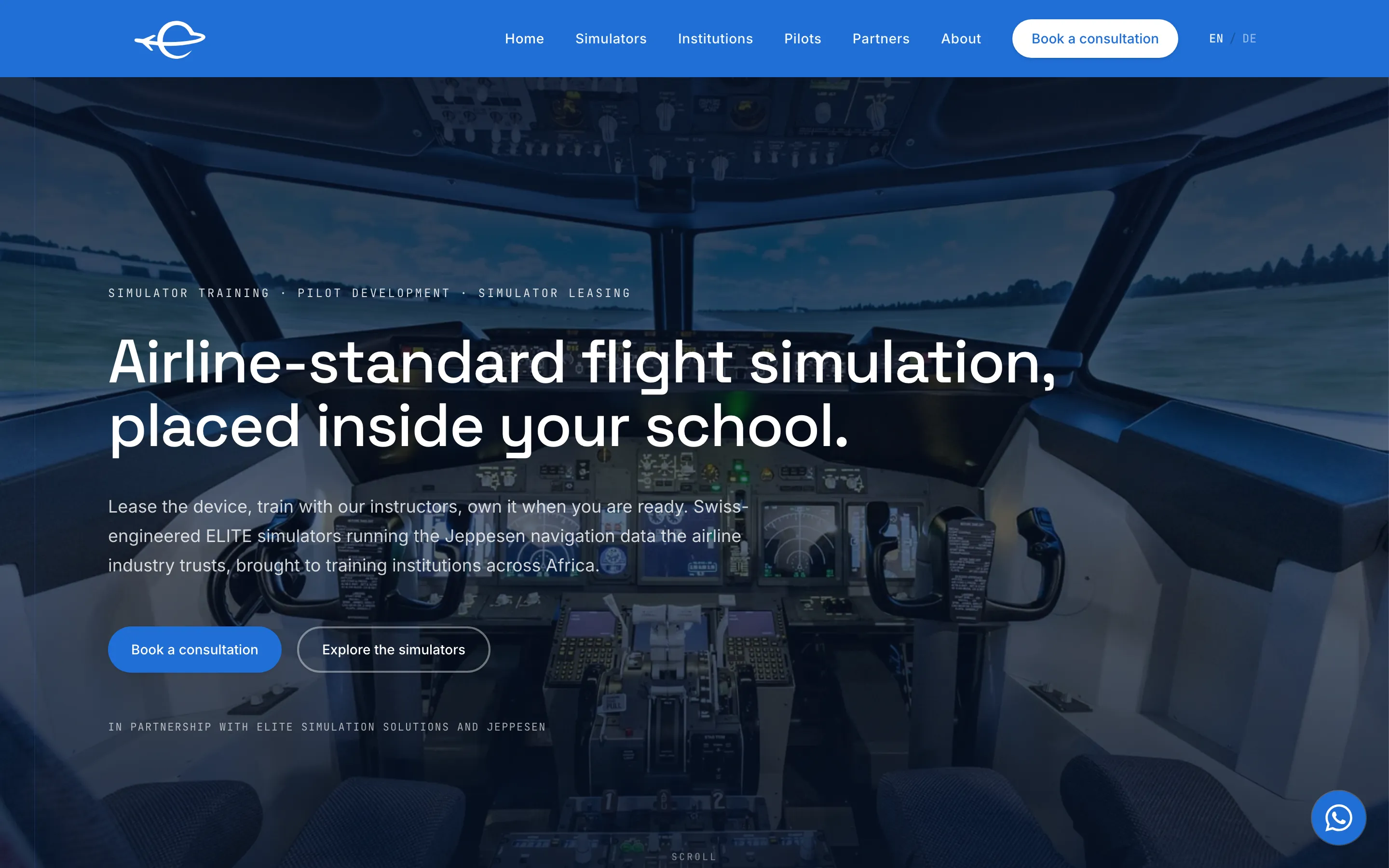
Applications rather than brochures: routing, logic and the internal tooling behind them. EPC Aviation sorts institutions, pilots and partners to the right action, in English and German.
How we work
We start by watching how the thing actually runs, including the workarounds. The workaround is usually the requirement.
We write the rules down as we understand them and hand them back to you with the assumptions listed. Nothing gets built on a guess we did not surface first.
Data model first, interface second. Get the structure right and the tool almost draws itself.
A working version in your hands early, with your real data in it, not a mock-up.
We back-test against your historical trips, jobs, months or campaigns and show you the variance table. If the model disagrees with the past, we find out which one is wrong.
Documentation, training and an agreed support window. An optional retainer if you want us to keep evolving it.
Working together
Fixed fee
A structured look at how your operation runs today, where the leaks are, and what is worth building. Delivered as a written diagnosis with a prioritised build sequence. Credited against a build if you proceed.
Fixed fee, phased payments
A scoped project. Typically a workbook system, an internal tool or a platform, delivered with documentation and training.
Monthly retainer
We hold the systems side of your operation: maintenance, iteration, new tooling as the work changes, and a standing line to us when something breaks.
No cookie-cutter packages. The audit is the honest way in: fixed, written down, and capable of telling you the build is not worth doing.
We only build what removes real work.
Questions
Usually not. Most engagements start by making what you already pay for work together, so information moves once instead of four times. We replace a tool only when the tool itself is what costs you time.
That is the failure we design against. Every build ships with SOPs, runbooks and training, so the system belongs to your team rather than to one person, or to us.
You do. Consent and data protection are built into how records are collected rather than bolted on afterwards, and you own the system and everything in it.
Yes, and we prefer to. We would rather leave your team able to maintain the thing than make you dependent on us. Where you have people in place, we build with them and document for them.
Then say so on the call. Send us the spreadsheet, the WhatsApp group, the process that lives in one person’s head, and we will tell you honestly whether this needs a system or just a better habit.
No pitch deck first. Send us the spreadsheet, the WhatsApp group, the process that lives in one person’s head. We will tell you honestly whether this needs a system or just a better habit.